

“Until the lion learns how to write, every story will glorify the hunter.” — African proverb
What would it mean to lead a school from an Afrocentric perspective in a way that is grounded in African realities, values, and aspirations? In other words, what would it look like to centre African knowledge systems, cultural values, and worldviews in how schools are shaped and sustained?
As education systems across the continent continue to evolve, there is growing recognition that effective school leadership cannot rely solely on imported models. It must reflect the lived experiences, cultures, and contexts of African learners and communities. In response to this need, the African Centre for School Leadership (ACSL) is developing an Afrocentric approach to school leadership, one that re-centres African knowledge, strengthens local relevance, and supports leaders to drive meaningful and inclusive learning in their schools.
Re-centring leadership in African realities
While global leadership models have contributed valuable insights, they often do not fully capture the social, cultural, and systemic contexts within which African school leaders operate.
Afrocentric leadership offers a powerful alternative—one that places African values and lived realities at the centre of practice. Grounded in philosophies such as Ubuntu, Ujamaa, Sankofa, Botho, and Seriti, it emphasises the following:
- Collective responsibility and community well-being
- Ethical and values-driven leadership
- Participatory decision-making and social cohesion
This shift does not reject global knowledge; rather, it seeks to rebalance it by ensuring that African perspectives are not only represented but actively shape leadership practice.
This approach aligns with continental aspirations, including the African Union’s Agenda 2063, which calls for African cultures and values to be embedded in development processes.
Sankofa as a guiding principle to reimagine school leadership in Africa.

At the heart of this work is Sankofa, a Ghanaian concept symbolised by a bird looking back while moving forward. Sankofa reminds us that progress is not linear. To move forward meaningfully, we must look back—to learn, to reclaim, and to reimagine.
Within the exploration of Afrocentric school leadership, Sankofa serves as a guiding framework:
- Looking back: What made leadership effective in African contexts?
- Understanding the present: What realities do schools face today?
- Shaping the future: How can leadership evolve sustainably?
Afrocentric leadership is not presented as the only model—but as a grounded, reflective approach that helps leaders navigate complexity with purpose.
Building the trajectory together
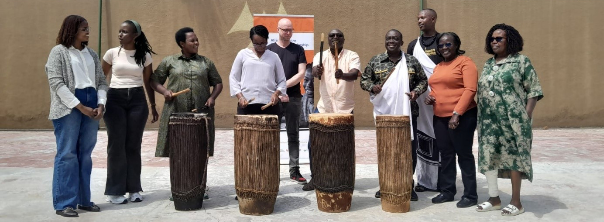
In March 2026, ACSL convened experts from Ghana, Kenya, and Rwanda for a week-long co-creation workshop. The focus was clear:
- Develop a Blended Exchange and Learning Trajectory1 (BELT) learning modules and practical exercises
- Design delivery approaches grounded in African andragogy
- Co-create assessments, and;
- Identify real-world case studies
But this was not a conventional workshop.
Rather than relying solely on presentations and theory, the week itself became an embodiment of Afrocentric facilitation. Participants engaged through storytelling, proverbs, and cultural symbols. A simple story—such as that of the “lazy man”—sparked deep reflection on responsibility and leadership.
The group also explored themes of gender equality, social inclusion, and community-based learning. Even the tools reflected this mindset, with discussions on how digital platforms like Moodle can be adapted to support communal, participatory learning.
Moments of cultural immersion—such as learning about the role of Ingoma drums in Rwandan society—opened new ways of thinking about leadership. Drums, used historically to announce events, mobilise communities, and accompany royal ceremonies became a metaphor for leadership as communication, coordination, and collective rhythm.
Learning from practice: a school visit that brought it all to life
The workshop extended beyond the meeting room. Participants visited GS Rosa Mystica, a school that embodies Afrocentric leadership in practice. The visit offered a rare opportunity to witness how values, leadership, and inclusion intersect in everyday school life.
The visit was more than observational—it was transformative.
Several themes stood out.
- Leadership as service: One of the strongest impressions was the idea of leadership as a calling rather than a position. School leaders and staff demonstrated a deep commitment to serving learners and the community. As oneworkshop participant reflected, “Leadership is not just a professional responsibility—it becomes a calling.”
- Inclusion as a lived reality: In this school, inclusion is not treated as a policy requirement but as a core value. Learners with diverse needs—including children with autism—are supported through tailored approaches, structured routines, and intentional care. Another workshop participant noted: “There is no disability—only different abilities.”
- Community as a key partner: The school’s success was rooted in strong community engagement. Parents, volunteers, and staff worked together, illustrating that education is a shared responsibility. “It’s not just the school—the whole community is part of making this work,” a proprietor at the school noted.
- Every child’s right to quality education: The visit challenged assumptions about learners with special needs, prompting participants to reflect on the potential within every child. Inclusion is not driven by the possibility that one child may be exceptional, but by the principle that all children have the right to quality education. As one workshop participant posed, “What if the solution to the world’s biggest problems lies in one of these children?”.
The last question above stayed with us long after we left GS Rosa Mystica. It is part of why the work being built through ACSL matters.
Returning to the Source: Shaping the Future
ACSL is currently developing a Blended Exchange and Learning Trajectory (BELT) on Afrocentric school leadership; an initiative that creates space for professional development providers across the continent to exchange experiences and explore practical ways of integrating Afrocentric perspectives into school leadership and leadership development.
The development of the Afrocentric approach to school leadership and the related BELT trajectory for school leadership professional development marks an important step in reimagining school leadership in Africa. It is not about replacing one model with another. It is about reclaiming space—for African voices, values, and knowledge systems.
By grounding leadership in context, culture, and community, ACSL is helping to build systems that are not only effective but also meaningful and sustainable.
In the spirit of Sankofa, this work reminds us that the future of African education will not be built solely through borrowed models, but through the wisdom, values, and possibilities already rooted across the continent. By looking back with intention, African school leadership can move forward with greater authenticity, relevance, and purpose.
About ACSL
The African Centre for School Leadership (ACSL) is a pan-African initiative dedicated to supporting governments in establishing and strengthening school leadership systems that enhance teaching quality, learning outcomes, and student wellbeing. ACSL is jointly coordinated by the Association for the Development of Education in Africa (ADEA), Education Sub-Saharan Africa (ESSA), the Forum for African Women Educationalists (FAWE), and VVOB – education for development.
The authors are grateful to Prof. Alphonse Uworwabayeho (University of Rwanda – College of Education), Prof. Catherine Kiprop (Moi University), Dr. Fay Hodza (PEAS), Ms. Genevieve Ayinkamiye (ACSL), Prof. George K. T. Oduro (Ministry of Education, Ghana), Dr Jacqueline Onyango (Kenya Institute of Curriculum Development and African Curriculum Association), Dr. Jef Peeraer (ACSL), Prof. Michael Boakye Yiadom (Institute of Educational Planning and Administration, University of Cape Coast) and Nuria Moreno (ACSL) for their expertise and participation in the March 2026 co-creation workshop and to the leadership and community of GS Rosa Mystica for their generosity and openness.
This article was prepared by the authors with support from AI-assisted editing tools to enhance clarity and structure. All views and content remain those of the authors.