Developing an Afrocentric approach to school leadership 

“Until the lion learns how to write, every story will glorify the hunter.” — African proverb

What would it mean to lead a school from an Afrocentric perspective in a way that is grounded in African realities, values, and aspirations? In other words, what would it look like to centre African knowledge systems, cultural values, and worldviews in how schools are shaped and sustained? 

As education systems across the continent continue to evolve, there is growing recognition that effective school leadership cannot rely solely on imported models. It must reflect the lived experiences, cultures, and contexts of African learners and communities. In response to this need, the African Centre for School Leadership (ACSL) is developing an Afrocentric approach to school leadership, one that re-centres African knowledge, strengthens local relevance, and supports leaders to drive meaningful and inclusive learning in their schools. 

Re-centring leadership in African realities 

While global leadership models have contributed valuable insights, they often do not fully capture the social, cultural, and systemic contexts within which African school leaders operate. 

Afrocentric leadership offers a powerful alternative—one that places African values and lived realities at the centre of practice. Grounded in philosophies such as Ubuntu, Ujamaa, Sankofa, Botho, and Seriti, it emphasises the following: 

  • Collective responsibility and community well-being  
  • Ethical and values-driven leadership  
  • Participatory decision-making and social cohesion  

This shift does not reject global knowledge; rather, it seeks to rebalance it by ensuring that African perspectives are not only represented but actively shape leadership practice. 

This approach aligns with continental aspirations, including the African Union’s Agenda 2063, which calls for African cultures and values to be embedded in development processes.  

Sankofa as a guiding principle to reimagine school leadership in Africa. 

At the heart of this work is Sankofa, a Ghanaian concept symbolised by a bird looking back while moving forward. Sankofa reminds us that progress is not linear. To move forward meaningfully, we must look back—to learn, to reclaim, and to reimagine. 

Within the exploration of Afrocentric school leadership, Sankofa serves as a guiding framework: 

  • Looking back: What made leadership effective in African contexts?  
  • Understanding the present: What realities do schools face today?
  • Shaping the future: How can leadership evolve sustainably?

Afrocentric leadership is not presented as the only model—but as a grounded, reflective approach that helps leaders navigate complexity with purpose. 

Building the trajectory together 

In March 2026, ACSL convened experts from Ghana, Kenya, and Rwanda for a week-long co-creation workshop. The focus was clear: 

  • Develop a Blended Exchange and Learning Trajectory1 (BELT) learning modules and practical exercises  
  • Design delivery approaches grounded in African andragogy  
  • Co-create assessments, and;  
  • Identify real-world case studies 

But this was not a conventional workshop. 

Rather than relying solely on presentations and theory, the week itself became an embodiment of Afrocentric facilitation. Participants engaged through storytelling, proverbs, and cultural symbols. A simple story—such as that of the “lazy man”—sparked deep reflection on responsibility and leadership. 

The group also explored themes of gender equality, social inclusion, and community-based learning. Even the tools reflected this mindset, with discussions on how digital platforms like Moodle can be adapted to support communal, participatory learning. 

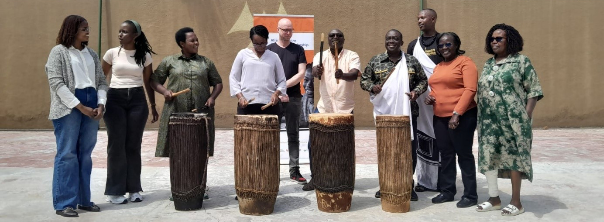
Moments of cultural immersion—such as learning about the role of Ingoma drums in Rwandan society—opened new ways of thinking about leadership. Drums, used historically to announce events, mobilise communities, and accompany royal ceremonies became a metaphor for leadership as communication, coordination, and collective rhythm. 

Learning from practice: a school visit that brought it all to life 

The workshop extended beyond the meeting room. Participants visited GS Rosa Mystica, a school that embodies Afrocentric leadership in practice. The visit offered a rare opportunity to witness how values, leadership, and inclusion intersect in everyday school life. 

The visit was more than observational—it was transformative. 

Several themes stood out. 

  • Leadership as service: One of the strongest impressions was the idea of leadership as a calling rather than a position. School leaders and staff demonstrated a deep commitment to serving learners and the community. As oneworkshop participant reflected, “Leadership is not just a professional responsibility—it becomes a calling.” 
  • Inclusion as a lived reality: In this school, inclusion is not treated as a policy requirement but as a core value. Learners with diverse needs—including children with autism—are supported through tailored approaches, structured routines, and intentional care. Another workshop participant noted: “There is no disability—only different abilities.” 
  • Community as a key partner: The school’s success was rooted in strong community engagement. Parents, volunteers, and staff worked together, illustrating that education is a shared responsibility. “It’s not just the school—the whole community is part of making this work,” a proprietor at the school noted. 
  • Every child’s right to quality education: The visit challenged assumptions about learners with special needs, prompting participants to reflect on the potential within every child. Inclusion is not driven by the possibility that one child may be exceptional, but by the principle that all children have the right to quality education. As one workshop participant posed, “What if the solution to the world’s biggest problems lies in one of these children?”. 

The last question above stayed with us long after we left GS Rosa Mystica. It is part of why the work being built through ACSL matters. 

Returning to the Source: Shaping the Future 

ACSL is currently developing a Blended Exchange and Learning Trajectory (BELT) on Afrocentric school leadership; an initiative that creates space for professional development providers across the continent to exchange experiences and explore practical ways of integrating Afrocentric perspectives into school leadership and leadership development. 

The development of the Afrocentric approach to school leadership and the related BELT trajectory for school leadership professional development marks an important step in reimagining school leadership in Africa. It is not about replacing one model with another. It is about reclaiming space—for African voices, values, and knowledge systems. 

By grounding leadership in context, culture, and community, ACSL is helping to build systems that are not only effective but also meaningful and sustainable. 

In the spirit of Sankofa, this work reminds us that the future of African education will not be built solely through borrowed models, but through the wisdom, values, and possibilities already rooted across the continent. By looking back with intention, African school leadership can move forward with greater authenticity, relevance, and purpose. 

About ACSL 

The African Centre for School Leadership (ACSL) is a pan-African initiative dedicated to supporting governments in establishing and strengthening school leadership systems that enhance teaching quality, learning outcomes, and student wellbeing. ACSL is jointly coordinated by the Association for the Development of Education in Africa (ADEA), Education Sub-Saharan Africa (ESSA), the Forum for African Women Educationalists (FAWE), and VVOB – education for development

The authors are grateful to Prof. Alphonse Uworwabayeho (University of Rwanda – College of Education), Prof. Catherine Kiprop (Moi University), Dr. Fay Hodza (PEAS), Ms. Genevieve Ayinkamiye (ACSL), Prof. George K. T. Oduro (Ministry of Education, Ghana), Dr Jacqueline Onyango (Kenya Institute of Curriculum Development and African Curriculum Association), Dr. Jef Peeraer (ACSL), Prof. Michael Boakye Yiadom (Institute of Educational Planning and Administration, University of Cape Coast) and Nuria Moreno (ACSL) for their expertise and participation in the March 2026 co-creation workshop and to the leadership and community of GS Rosa Mystica for their generosity and openness. 

This article was prepared by the authors with support from AI-assisted editing tools to enhance clarity and structure. All views and content remain those of the authors. 

From evidence to action: Reflections from Tanzania’s school leadership engagement Week

The Tanzania School Leadership Engagement Week ended on 17th July. Beyond presenting new evidence, iallowed stakeholders to examine and chart the future of school leadership in Tanzania — and to agree the actions needed to translate evidence into stronger policy, better practice and lasting reform.

Every education system is shaped by the quality of its leadership. Curricula change, policies evolve and investments increase. But sustainable improvements in learning depend on leaders who can translate those efforts into better teaching, stronger schools and improved outcomes for every learner. Across Africa, education systems increasingly recognise school leadership as one of the most powerful levers for improving learning outcomes, and Tanzania is moving decisively to act on that recognition. The direction is set in the Education and Training Policy, 2014 (2023 Edition), which emphasises quality education, effective governance and capable leadership.

That vision was interrogated during the Engagement Week, organised by the Agency for the Development of Educational Management (ADEM) in partnership with the African Centre for School Leadership (ACSL) under the Leaders in Teaching (LiT-LEAD) initiative. Officially opened by Prof. Carolyne Nombo, Permanent Secretary in the Ministry of Education, Science and Technology, on behalf of the Minister, Hon. Prof. Adolf Mkenda, the week provided a national platform to examine new evidence and identify practical priorities for strengthening school leadership across Mainland Tanzania and Zanzibar.

Welcoming participants, Sarish Hiribae, Country Programmes Manager for ACSL Tanzania, framed the engagement as an opportunity to deepen a shared national commitment.

“This week demonstrates what is possible when government institutions, development partners and academia come together to ensure that every school is led by a visionary leader who will contribute to students’ success.”

Evidence as a Foundation for Reform

The dissemination of the Tanzania School Leadership Mapping Report and the School Leaders Training Needs Assessment provided the first comprehensive national picture of school leadership in the country.

The Training Needs Assessment found that 85 per cent of respondents identified major gaps in leadership and management competencies — strategic planning, instructional leadership, financial management, conflict resolution and ICT, while 90 per cent called for comprehensive professional development. The Mapping Report showed that many heads of schools assume leadership roles without formal preparation, balance teaching with extensive administrative responsibilities, and use school data primarily for compliance rather than school improvement.

There was encouraging progress too. Nearly three-quarters of heads of schools and their deputies demonstrated readiness to support implementation of the Competency-Based Curriculum, particularly through instructional supervision and classroom observation. And research on school leadership has expanded from just three publications in 2010 to thirty-seven in 2024 — though gaps remain, particularly on rural leadership and gender representation among researchers.

Taken together, the reports pointed to a sharper conclusion than either offers alone: Tanzania does not lack school leadership initiatives. It lacks an integrated school leadership system — the standards, preparation pathways, coordination mechanisms and evidence needed to turn individual efforts into sustained institutional practice.

The week’s task was therefore not to introduce a new agenda, but to determine how existing national priorities become action.

From Evidence to Policy and Practice

The conversation quickly turned from what the evidence showed to what it required.

Representatives from the Ministry of Education, Science and Technology (MoEST), the President’s Office – Regional Administration and Local Government (PO-RALG), the Ministry of Education and Vocational Training Zanzibar (MoEVT), the Foreign, Commonwealth and Development Office (FCDO) and the Open University of Tanzania identified three priorities: gender-responsive policies that open pathways for more women to assume leadership positions; continuous professional development grounded in evidence; and development partner support that strengthens government systems rather than substituting for them.

For Zanzibar, a persistent challenge stood out: school leaders often receive conflicting directives from different administrative levels. Panellists also acknowledged that while teacher professional development has expanded significantly, improvements in classroom practice have been slower than expected — a gap that effective school leadership exists precisely to close. Both challenges pointed to the same remedy: strengthening formal recognition of school leadership roles and responsibilities through the ongoing review of the Education Act (Mainland), 2014 and the Zanzibar Education Act, 2006.

The discussion also stretched the definition of leadership itself. A representative from the Open University of Tanzania encouraged teacher education institutions to embrace Ubuntu as a guiding philosophy — leadership as collaborative and relational rather than centred on a single individual, shared among school leaders, teachers, education officers, policymakers and communities.

Research that Serves Practice

Research featured not as an academic exercise, but as a working tool of reform.

The launch of Tanzania’s National School Leadership Research Agenda marked a milestone in connecting research, policy and practice, and the commitment was tested immediately. All fourteen Tanzanian researchers supported through the ACSL Grants Programme presented their proposals to government officials, practitioners and the Research Advisory Committee, receiving structured feedback before implementation begins. Because the studies respond directly to challenges identified in the national mapping, future evidence will speak to national priorities from the outset.

Delivering the keynote address, Prof. Tage Biswalo, a member of the Research Advisory Committee, urged researchers to see their work as a driver of education transformation.

“Research grants are far more than financial awards. They represent strategic investments in knowledge generation, innovation and educational transformation.”

He challenged researchers to produce knowledge that is “for us, by us” — grounded in local realities, shaped by African expertise and capable of informing policy while improving practice.

Sustaining National Collaboration

One message echoed throughout the week: stronger school leadership cannot be built through isolated initiatives. Without a formal coordination mechanism, research findings risk remaining on shelves rather than shaping policy, and well-intentioned programmes operate in silos rather than advancing a shared national agenda.

To address this, participants endorsed the establishment of a National School Leadership Task Force. The Task Force will provide strategic advice to the Ministry of Education on school leadership development, ensure that research findings inform policy and practice, and track progress against agreed results. Its establishment marks a formal shift from fragmented initiatives to a coordinated, evidence-driven approach — closing the gap between what research shows and what policy delivers.

Closing the week on behalf of the Permanent Secretary, Dr Hussein Omar Mohammed, Deputy Permanent Secretary in the Ministry of Education, Science and Technology, described the dissemination of the two reports as a major milestone. He welcomed the Research Agenda as an investment in locally generated evidence and emphasised that sustained collaboration across institutions will be essential to translating commitments into lasting improvements in policy and practice.

The Tanzania School Leadership Engagement Week marked an important step towards a coherent national school leadership system, and offered a model of country-led, evidence-driven engagement that other African countries can learn from.

The conversations have concluded. The evidence is in hand. The next chapter will be defined by how effectively Tanzania translates it into stronger leadership, better-supported teachers and improved learning outcomes for every child.

Effective School Leadership is Central to Africa’s Education Transformation Agenda

This blog draws on reflections and discussions from the 13th AFTRA Conference and 15th Roundtable, Gaborone, Botswana, and on ongoing work under the African Centre for School Leadership (ACSL). ACSL is coordinated by ADEA, and implemented in collaboration with ESSA, FAWE, and VVOB – Education for Development.

From 5th to 7th May 2026, education leaders, policymakers, researchers, and practitioners from across Africa gathered in Gaborone, Botswana, for the 13th AFTRA Conference and 15th Roundtable. The conference was officially opened by His Excellency Duma Gideon Boko, President of the Republic of Botswana — a signal of the political weight the country places on education, youth development, and continental collaboration. We attended as representatives of the African Centre for School Leadership. We came to the event with questions. We left with a stronger sense of both urgency and direction.

Across three days of discussions, one message recurred with striking consistency: effective school leadership is not a technical sub-issue within the education reform conversation. It is a central determinant of whether reform actually works.

This is not a new argument. The evidence has been building up for years. Effective school leaders shape school culture, strengthen teaching quality, support teacher motivation, improve accountability, and create enabling conditions in which learning can thrive. Leadership is, in many ways, the bridge between policy ambition and classroom practice. And yet, across much of the continent, it remains insufficiently institutionalized. Leaders are appointed without adequate preparation. Standards and competency frameworks are weak or inconsistent. Professional development is fragmented, donor-dependent, and often disconnected from the day-to-day realities of leading a school. The result is a persistent gap between what policy intends and what implementation delivers.

What was encouraging in Gaborone was seeing that gap named explicitly — and at the highest levels. In the communiqué from the Ministerial Session held on 5 May 2026, Ministers of Education across Africa affirmed that effective school leadership is a key determinant of teacher retention, professional performance, improved learner outcomes, and competency acquisition, and committed to strengthening school leadership training as a specialised professional pathway across the continent. Botswana’s Minister of Child Welfare and Basic Education, Hon. Mrs. Kebuang Nono Kgafela-Mokoka, reinforced this, underlining the importance of leadership, policy alignment, and continental collaboration in strengthening education systems. When ministers use a communiqué to name school leadership as a strategic professional track rather than an administrative function, something is shifting in how the agenda is being understood.

Our contribution to the conference drew attention to what that shift must mean in practice. Effective school leadership cannot be understood as the responsibility of individual principals working in isolation. It must be understood as a system function, one that requires coherent structures at every level, from ministries and district offices to teacher development institutions, school communities, and the professional networks that connect them. One of the framings we offered, which generated genuine discussion, was the move from talking about instructional leadership toward talking about leadership for teaching and learning. The distinction matters. The first locates the work at the level of the principal. The second distributes responsibility across the whole system and acknowledges the relational, collaborative nature of leadership as it operates in African contexts.

The conference also brought into sharp focus something we encounter in ACSL’s work continuously: the professional development of school leaders cannot remain a project. It cannot be short-term, donor-driven, or disconnected from national systems. Meaningful leadership development requires continuity — coaching, mentoring, peer learning, reflective practice, certification pathways — embedded within institutions that will sustain them beyond the next funding cycle. Several African countries are already moving in this direction, and their experiences show that progress is possible when governments, practitioners, researchers, and development partners align around shared priorities rather than parallel agendas.

Research was a recurring theme throughout the conference, and rightly so. Much of the global literature on school leadership originates from contexts that look very different from African education systems. International evidence has value, but African systems need stronger, locally generated evidence capable of informing policy and practice on their own terms — on leadership in low-resource settings, on inclusive and gender-responsive leadership, on what works in fragile and conflict-affected contexts, on the relationship between leadership and teacher wellbeing. ACSL’s expanding research agenda is a direct response to this need. But it is also clear that research must not end in publication. Evidence must find its way into policy dialogue, into leadership standards, into the decisions that shape how school leaders are prepared, supported, and held accountable. The link between research, policy, and practice is where the long-term work of system transformation actually happens.

The AFTRA Conference reflected real momentum. The ministerial communiqué matters. The conversations matter. But momentum is not transformation, and commitments are not yet systems. What Africa’s school leaders need — and what learners across the continent deserve — is sustained institutional investment: in leadership policy frameworks, in professional development ecosystems, in coaching and mentoring structures, in evidence systems, and in collaborative platforms capable of holding this agenda across borders, cycles, and changes in government.

Education reform is ultimately experienced in classrooms, schools, and communities. The quality of that experience depends heavily on the quality of leadership — not leadership as administration, but leadership that supports teachers, enables learning, advances inclusion, and builds the environments in which every child can thrive. Gaborone reminded us that more people across the continent understand this. Turning that understanding into sustained action is the work that remains.

From Nairobi with Purpose: Reflections on the 1st KEMI International Conference 

The Safari Park Hotel in Nairobi fell quiet on the evening of Friday, 17th April 2026. Five days of high-level engagements on best practices, innovations, challenges, and opportunities around improving school leadership — in terms of policy, practice, and research challenges —came to a close. Over 1,700 participants, joining in person and virtually from the 16 plus countries across Africa, Europe, Asia, and North America began the journey home carrying the weight of what had been said, and the responsibility of what must now be done. 

The 1st International Conference of the Kenya Education Management Institute (KEMI) was, by any measure, a landmark event. Crucially, government is showing the sort of leadership that births results. The initiative to hold the conference echoes the consistent push, championed by organizations like ADEA, for government ownership.  

For the African Centre for School Leadership (ACSL), it was something more personal. ACSL did not simply attend this conference. As a core partner to KEMI, keynote contributor, presenter of the continent’s most comprehensive school leadership evidence reviews, panel moderator and day chairperson — ACSL was woven into the fabric of every day of the conference proceedings. This blog reflects what we heard, what we contributed, and what we believe must follow. 

What the week confirmed 

The conference opened on Monday with a keynote speech from the ADEA Executive Secretary, Albert Nsengiyumva, that set the tone — anchored on the key policy messages during the official opening — for everything that followed. His argument was precise yet provocative: Africa is not short of knowledge on school leadership. The research exists. The frameworks exist. Think of CESA 2026–2035, the ADEA Triennale, the African Continental Teacher Qualification Framework etc. What is missing is the political will to act, and the accountability systems to ensure that what is promised is delivered. 

By the time the conference closed on Friday, that argument had been tested, reinforced, and deepened across five days of keynotes, panels, roundtables, abstract and research presentations. What emerged was not a new agenda. It was a clarified one — sharper on what is working, more honest about what is not, and more specific about what concrete action must look like. 

On what is working, the conference was genuinely encouraging. Conversations recognized school leadership as a critical driver of quality education outcomes— and this conference is itself a testament to that. Competency-based learning approaches and learner-centred pedagogies are expanding across the continent. Multi-stakeholder collaboration between governments and development partners is strengthening. Afrocentric leadership models — grounded in Ubuntu philosophy and indigenous knowledge systems — are gaining the institutional attention they have long deserved. A good number of school leaders participated in the conference who showed a high level of commitment to achieve excellence on their performance. They featured on panels, sharing their experiences, calling for more support but essentially, demonstrating the value of creativity and impactful leadership. 

On what requires strengthening, the conference was equally honest. The gap between policy design and school-level implementation persists — and in many systems, widens — coupled with weak alignment to regional and continental frameworks. Professional development frameworks for school leadership remain fragmented and unstandardised. Research is not consistently translated into policy or practice. Education financing remains insufficient and unevenly protected. Community engagement in school governance is still largely ceremonial rather than substantive. Achieving gender balance, including strengthening women participation at leadership levels remain crucial.  

These are not new findings. But having them named and validated by over 1,700 stakeholders in a single week — representing governments, universities, development partners, civil society, and school leaders themselves — gives them a weight and a political visibility that isolated reports cannot match. 

ACSL’s contribution across the week 

ACSL’s presence at the conference was substantive and multi-dimensional. Albert Nsengiyumva opened the conversation on Monday with his keynote speech around eight pillars for education leadership transformation. ADEA’s Senior Program Officer, Shem Bodo moderated the first panel discussion on positioning school leadership as a strategic driver of education reforms. Tom Vandenbosch, the General Director of VVOB, delivered the Day 2 keynote address on the future of school leadership professional development, and the closing address, reflecting on the swahili proverb that one finger alone, is not enough (kidole kimoja hakivunji chawa). Joyceline Kirezi and Caren Namalenya presented the findings of the ACSL Continental Mapping Report on School leadership — one of the most recent comprehensive evidence syntheses on school leadership ever conducted on the African continent, drawing on 1,759 research publications and input from 97 stakeholders across 16 countries.  

Chantal Kabanda Dusabe moderated a panel on transforming professional development beyond compliance. Sandrine Ishimwe brought ACSL’s gender and equity voice to a panel on resilience and inclusion. Mamadou Lamine Sow moderated a session on financing education reform. On day 5, Leila Abdullahi moderated a panel on bridging the evidence and policy gap. ACSL also chaired the full proceedings of Day 4 — overseeing sessions on digital transformation, a roundtable with school heads on CBC implementation, and a panel on education financing. 

In between, we presented an abstract on the methodological approaches we adopted for the school leadership mapping across countries.  

Taken together, this represents the most concentrated demonstration of ACSL’s convening depth and technical breadth on a single platform to date. It is how we understand our role in terms of facilitating conversations on school leadership. We came not to observe but to contribute — and the feedback from delegates across the week affirmed that ACSL’s voice in this space is both credible and needed. 

The Continental Mapping Report: a landmark for the sector 

The formal launch of the ACSL Continental Mapping Report on Day 2 deserves particular reflection. This report is not a position paper or a policy brief. It is a rigorous, multi-method evidence synthesis — built on desk reviews, stakeholder interviews, and validation workshops across 16 countries, produced over an extended period of fieldwork and analysis.  

Its findings do not flatter. They document a continent where school leadership is increasingly recognised in policy but insufficiently resourced in practice; where professional development exists but remains project-based, fragmented, and largely disconnected from career progression; where the evidence base is growing but remains uneven, inaccessible, and underutilised. 

But the report also documents genuine momentum — and it provides a fresh continental baseline from which progress can be measured. That is its most enduring contribution: not just a snapshot of where Africa is on school leadership, but a foundation from which the sector can hold itself accountable for where it goes next. 

What must follow 

The conference produced a clear call to action, organised around nine pillars: governance and institutional reform; sustainable and equitable financing; leadership capacity development; collaborative and community-centred leadership; data-driven leadership and research; technology and innovation with an equity focus; equity, inclusion, and social justice; regional and continental harmonisation; and resilient leadership for crisis and emergency contexts. 

KEMI has committed to developing a roadmap and monitoring framework to track implementation of the conference recommendations — reporting on progress at the next KEMI conference, with updates to stakeholders in between. That commitment is significant, and ACSL welcomes it. 

For our part, ACSL leaves the Nairobi conference with a deepened partnership with KEMI, renewed conversations about expanding the school leadership agenda in Kenya beyond the foundation phase, and a clearer sense of the specific policy and practice gaps where our technical support can make the most difference. 

The one message we carry most firmly from the week is the one Albert placed before delegates on the opening day and that echoed in every session that followed. The knowledge exists. The frameworks exist. The tools exist. What determines whether any of it produces change in the life of a child in a rural school in Kenya, or Senegal, or Mozambique — is whether the people in positions of power choose to act on what they know. 

One billion young people are waiting for that choice to be made! 

Transforming education leadership in Africa: eight pillars we cannot afford to ignore

Keynote Address at the 1st KEMI International Conference, Nairobi, Kenya, 13 April 2026

Distinguished guests, colleagues, fellow believers in the transformative power of education.

I want to begin with a number. Not a target, not a projection — a fact. By 2040, Africa will be home to the largest youth population the world has ever seen. More than one billion young people of working age. One billion minds that will either be equipped — or abandoned. One billion futures that will either flourish — or be lost.

The question — the only question that matters — is this: What must governments concretely do now to transform the leadership of those systems?

Drawing on the 2025 ADEA Triennale Synthesis Report and the Continental Education Strategy for Africa — CESA 2026 to 2035 — I present to you eight pillars, and one cross-cutting dimension, where political commitment and institutional courage must converge if we are serious about transformation.


Pillar 1: Governance and Institutional Reform

Let us start where every education system either stands or falls: governance. 

Decentralisation is not transformation. Decentralisation without accountability is merely dispersal. The Triennale was unsparing on this point — it identified middle-tier leadership: district officers, school support officers, instructional coaches — as the chronically under-resourced link where policy transformations most often fail.

We need Afrocentric professional standards for school principals. We need career pathways with teeth — licensing requirements, performance standards, and real consequences for persistent failure. And we need to invest in and formally recognise the African Centre for School Leadership as the institutional home for this work.

CESA 26-35 is explicit: Objective Six of its Strategic Area on Teachers, Educators, and Caregivers calls directly for investing in school leadership, including the share of female leaders. Not as a footnote. As a strategic objective.

School leaders are not administrators. They are the single most powerful lever in a school system after the quality of teaching itself. And yet in some African countries, a teacher can become a principal without any leadership training. That is not governance..

Governance must also anticipate the unexpected. Crisis management units embedded at every tier — national, district or county, and school — are not a luxury. They are the infrastructure that determines whether a system bends or breaks when emergencies arrive.


Pillar 2: Sustainable and Equitable Financing

The numbers in CESA 26-35 are sobering. Between 2016 and 2022, the median African country saw education spending fall from 16% to 14.5% of total government expenditure. Moving in the wrong direction. Against a benchmark of 20%. Against a UN recommendation of 6% of GDP. Against a continent that allocates barely 3.7%.

Africa does not have an education financing problem. It has an education financing priority problem.

The Triennale’s most politically significant contribution was to name this clearly: governments must start treating education as a strategic investment, not a cost.

For leadership specifically, this means budget lines for principal training academies, CPD infrastructure, and middle-tier coaching must be protected — especially during fiscal pressure, when they are the first to be cut.

One final point on financing that must be said plainly: education budgets are most vulnerable to cuts precisely when they are most needed — during fiscal crises, conflicts, and emergencies. Ring-fencing leadership development expenditure against these pressures is not a technical matter. It is a test of political commitment.


Pillar 3: Leadership Capacity Strengthening

I want to be direct: capacity strengthening in Africa has a credibility issue.

Too many of the “capacity strengthening” programmes are single workshops in hotel conference rooms, attended by nearly the same people, producing reports that are hardly read, and changing little.

The Triennale put it plainly: continuous professional development (CPD) needs to be made mandatory, systemic, and embedded in policy. For education leaders, this means annual CPD hours as a licensing requirement. Competency-based micro-credentials replacing generic certificates. Digital platforms that track participation and tie it to career progression.

We must anchor these national systems to the continental architecture that the African Union has already built: the African Continental Framework of Standards and Competencies for the Teaching Profession, the African Continental Teacher Qualification Framework, the Teacher Mobility Protocol. These instruments are not optional extras — they are the foundation on which credible national systems must be built.

Capacity strengthening must also prepare leaders for the unexpected. Trauma-informed leadership, emergency pedagogy, and psychosocial support are not specialist add-ons — they are core competencies for any education leader working in Africa today.

And leadership development must begin earlier. Not with the principal, not at the district, county, or provincial office. But in the classroom. This means leadership modules in pre-service teacher education, mentorship programmes pairing experienced leaders with emerging ones, and professional learning communities that operate with a coaching orientation — not an inspection one.


Pillar 4: Collaborative and Community-Centred Leadership

There is a leadership model deeply embedded in African philosophical tradition that the world is only now beginning to appreciate. Ubuntu. I am because we are.

And yet our school governance structures often contradict this entirely — communities consulted only ceremonially, School Management Committees with no real authority, parents informed rather than involved.

The Triennale called for governments to empower communities to participate actively and sustain the learning process. Not advise. Not consult. Participate. Sustain. That is a fundamentally different mandate.

And beyond communities — multi-stakeholder education compacts. Ministries, civil society, traditional leaders, the private sector, and learner bodies co-designing national strategies. South-South collaboration platforms through the African Union, ACSL, RTIA, and the AU Regional Economic Communities.

We are not short of African wisdom on education leadership. We are short of the institutional structures that let that wisdom flow from communities into policy.


Pillar 5: Data-Driven Leadership and Research

You cannot lead what you cannot see. And you cannot improve what you do not measure.

But let me be clear: this is not a call for more data for Ministries. It is a call for quality data — data that reaches leaders. Data that empowers principals to make instructional decisions. Data that enables officers at central and sub-national levels to target support. Data that gives School Management Committees and Parent-Teacher Associations real visibility into how their school is performing.

CESA 26-35 calls this EMIS 2.0 — the shift from aggregate statistics to individual learner tracking. Real-time. Disaggregated. Actionable. Designed not to produce annual reports, but to drive daily leadership decisions.

And alongside robust data systems, we need African research on African leadership. Not imported models that we take as is, but those which we can contextualise. We need African universities and think tanks, resourced to generate the evidence base that informs African leadership.

Because data without political accountability is just a dashboard nobody looks at, the Triennale called specifically for empowering political leaders and policymakers to use available data in meeting the promises they made to citizens. Annual school performance reports that are public. Parliamentary briefings that are regular. Community scorecards that are binding.


Pillar 6: Technology and Innovation

AI is already here. It is in our classrooms whether we have planned for it or not.

The question is not whether to embrace technology in education leadership. The question is whether we will design it for the last mile — the rural school with intermittent electricity and a principal who has never opened a dashboard — or only for the well-connected urban schools that need it least.

EdTech equity means offline-first tools, local language interfaces, and bandwidth-aware design. Digital CPD platforms that track professional development must work in the schools where leadership is most needed, not only in capitals.

And we must prepare education leaders for responsible AI. Not to fear it — to govern it. To ask: whose values does this AI algorithm reflect? Whose children does this system serve? These are leadership questions. They belong in every leadership development programme on this continent.


Pillar 7: Equity, Inclusion and Social Justice

In most African school systems today, a child’s chance of being taught by a skilled, supported, motivated teacher — and led by a competent, empowered principal — depends almost entirely on where that child was born. Representation at leadership level shapes every other equity outcome in a school system.

CESA 26-35’s Strategic Area Six — Gender, Equity, and Inclusion — makes the case not only morally but economically. Female school leaders are associated with better learning outcomes for all children. They reduce gender stereotypes. They serve as mentors for girls. And yet in most countries, women remain dramatically underrepresented in school leadership — despite, as the data shows, staying in the profession longer than their male counterparts.

Gender-disaggregated leadership data. Published promotion criteria. Mentorship programmes for women leaders. Quotas where underrepresentation is severe. These are not radical asks. They are basic governance hygiene.

And beyond gender — school leaders must be held accountable for equity outcomes: for learners with disabilities, for conflict-affected youth, for displaced and refugee learners, for girls who are at risk of dropping out.


Pillar 8: Regional and Continental Harmonisation

We are one continent. Fifty-four nations. Hundreds of languages. Different school systems.

But our biggest challenges — teacher shortages, leadership skill gaps, financing deficits, learning poverty — do not respect national borders. Neither do refugee crises, displacement flows, or the learning losses they leave behind. And our solutions should not either.

CESA 26-35 provides the overarching continental framework. ADEA provides the convening architecture. The African Continental Teacher Qualification Framework provides the portability mechanism. Initiatives like ACSL and RTIA, and the RECs platforms, provide the regional exchange platform.

What is needed now is for governments to actively align national leadership frameworks to this continental architecture — not as an external compliance exercise, but because the continent’s diversity of leadership experience is our greatest untapped resource.

A principal in Kenya who transformed her school’s learning outcomes has something to teach a district officer in Senegal. A Minister in Ghana who built a national leadership academy has something to offer a counterpart in Mozambique. We must build platforms that make this exchange systematic, not accidental.


The Cross-Cutting Dimension: Resilience, Crisis and Conflict Readiness

I have spoken of eight pillars. But there is a ninth dimension — one that does not sit alongside the others but runs through all the pillars. And on a continent where 244 million children and young people are currently affected by armed conflict, climate-induced disaster, or forced displacement, it is a dimension we cannot afford to treat as an afterthought.

The question is not whether African education systems will face crisis. They already are. The question is whether our leaders will be prepared.

Large class sizes are the daily reality for the majority of African school leaders. Distributed leadership — where teachers lead within their classrooms and communities within their schools — is not a compromise. It is the only model that can work at scale.

Emergency situations demand that crisis-sensitive planning be embedded in normal governance — not built from scratch when disaster strikes. Every dollar invested in preparedness saves up to fifteen dollars in recovery. And risk data must be in EMIS — not only achievement data.

Conflict and displacement test the very soul of educational leadership. Crisis-affected teachers and community members are the most knowledgeable about their context — and the furthest removed from the decisions that affect them. International actors must support local leaders, not bypass them. Trauma-informed leadership is not a specialist skill. It is a baseline requirement.

Local leadership is not a principle to aspire to in times of crisis. It is the only thing that works.

Resilience is not a separate strategy. It is what all eight pillars must be built to deliver.


Finally: Let Us Walk the Talk

The 2025 ADEA Triennale chose its words carefully when it named its outcome document Walk the Talk. Because the gap between what we know and what we do in African education is not a knowledge gap.

We know what works. We have known for decades. We have the research, the frameworks, the continental strategies, the regional platforms. What we too often lack is the political will to implement — and the accountability systems to ensure that what is promised is delivered.

None of these eight pillars is new. None of them is beyond the capacity of African governments to implement. And none of them will happen automatically — not from a strategy document, not from a conference resolution, not from a keynote speech.

They will happen when a Minister of Finance agrees, in a budget negotiation, to protect the line for leadership development.

They will happen when a district, provincial, or county officer, for the first time, has real-time data on which schools are failing — and the authority to act on it.

They will happen when a female principal in a rural school in the Sahel has the training, the support, and the authority to lead — and knows that her government sees her, and is investing in her.

Education leadership transformation is not a technical problem awaiting a technical solution. It is a political commitment to equity. A cultural investment in African identity and knowledge systems. And a generational responsibility to the one billion young people whose futures depend on the decisions we make — and the actions we take — in rooms exactly like this one.

Africa does not need more policy documents. It needs the political will to implement what is already known.

The headwinds are real. But the direction is clear. Let us walk the talk. Together.


Albert Nsengiyumva is Executive Secretary of the Association for the Development of Education in Africa (ADEA) and a champion of the African Centre for School Leadership (ACSL). This address was delivered as the keynote speech at the 1st International Conference of the Kenya Education Management Institute, at the Safari Park Hotel, Nairobi, 13 April 2026. ACSL is a coalition of partners coordinated by ADEA, ESSA, FAWE, and VVOB.

Waiting to Lead: What African Schools Lose When Young Women Are Overlooked

Across many African education systems, leadership is something one is expected to grow into slowly. Years of service matter. But there is an unintended consequence: youth leadership is often delayed rather than developed. 

In Uganda, for instance, teachers typically move through classroom roles, senior responsibilities, and deputy positions over 8–12 years, with headship expected only after a decade or more of active service (Ministry of Education and Sports Uganda, 2008CPD Framework, 2017). These guidelines are important. Experience matters, But systems are likely to miss the opportunity to benefit from fresh energy, new ideas, and adaptive thinking.  

For young women, this delay is even more pronounced. 

Although maternity leave is legally protected in most education systems, leadership pathways that emphasise seniority and uninterrupted service can unintentionally disadvantage women. Eligibility for school leadership often depends on years accumulated in specific roles and access to acting leadership opportunities, both of which may be postponed by maternity-related career breaks. As a result, readiness is often judged by uninterrupted service rather than demonstrated competence (UNICEF Innocenti Research Centre, 2022;UNESCO, 2024World Bank, 2023). The Global Education Monitoring Report (UNESCO, 2025) further notes that many leadership pathways assume linear, uninterrupted careers, a dynamic that can create missed opportunities and delay women’s advancement into leadership roles.

Female school leaders remain significantly underrepresented, accounting for only 9%–21% of school leaders in most African countries (UNICEF Innocenti Research Centre, 2022). This persists despite compelling evidence that schools led by women indicate higher rates of student progression, improved learning outcomes, and lower absenteeism  (UNICEF Innocenti Research Centre, 2022World Bank, 2023). These findings challenge long-held assumptions about leadership readiness, yet they have not meaningfully reshaped leadership pathways.

The gap between evidence and practice was brought into sharp focus during a recent convening of the African Centre for School Leadership (ACSL), held in Nairobi in February 2026. School leaders reflected on their journeys. Among them was one story that captured how structural barriers play out in real life.

Leadership in Practice: A Young Woman’s Journey from the Ground

 
Ms. Phyllis A. Wijenje​, FathiladhimPrimary & Secondary School, Mombasa- Kenya
Ms. Phyllis A. Wijenje, a young woman school leader from Fashilidhan Primary and Secondary School in Mombasa, Kenya, described entering leadership not through encouragement, but persistence. 

She stepped into spaces where relationships were already established, and belonging felt negotiated rather than assumed.
“You know when you go to meetings,” she reflected, “you find the older women school leaders who have formed their own circles. They have already built relationships, and it is difficult for them to accommodate you.” 

Her experience highlights a quieter but persistent barrier facing young women leaders: the absence of mentorship and professional networks when most needed. Leadership, for her, meant learning on the job while constantly proving her legitimacy, often without structured guidance or affirmation. 

What shifted her trajectory was formal leadership and management training she received from the Kenya Education Management Institute (KEMI). This training did not replace experience; rather, it strengthened it. It built her confidence, sharpened her practical skills, and provided a professional foundation that complemented her years into leadership. Today, she is recognised as one of the country’s high-performing school principals.

Her story matters because it reflects a broader moment of change in African education systems.

A Changing Context Demands a New Definition of Readiness 

Countries such as Rwanda, Kenya, Tanzania, and Uganda, Competency-Based Curriculum (CBC) reforms are redefining effective school leadership. These reforms call for participatory, learner-centred leadership (Competency-based school leadership) that extends beyond the school, requiring meaningful engagement with teachers, parents, communities, and local institutions to support holistic learning (Global Education Monitoring Report, 2025). 

Leadership is no longer confined to administration; it is increasingly relational, outward-facing, and deeply collaborative.

At the same time, education systems are adapting to digital changes and the rise of artificial intelligence. Today’s school leaders must be adaptable, innovative, and comfortable with change. These qualities are often more visible among younger leaders, especially when they are supported through structured training and mentorship.

Research links female school leadership with more collaborative practices, stronger teacher engagement, and more inclusive school environments, key drivers of school effectiveness, particularly during periods of such reform (UNESCO, 2024). Yet leadership readiness continues to be measured primarily by years served rather than impact delivered.

Redefining Readiness

Being young. Being a woman. Being a leader. 

This is not about bypassing experience. It is about redefining readiness. 

Leadership potential can be cultivated deliberately through early investment, structured training, mentorship, supportive networks, and inclusive leadership pathways.

If African education systems are serious about CBC reforms, equity, and improved learning outcomes, leadership pipelines must evolve. Systems must open doors earlier for youth, deliberately support women, and treat leadership development as a competency, evidence and impact–driven investment, rather than a reward for longevity.

The evidence is clear.

And stories, such as Ms. Phyllis Wijenje’s, remind us that when young women are ready to lead but made to wait, schools and students lose more than time.

Acknowledgement

This blog draws on insights from the African Centre for School Leadership (ACSL) validation convening held in Nairobi in February 2026. ACSL is a partnership coordinated by the Association for the Development of Education in Africa (ADEA) and implemented with Education Sub Saharan Africa (ESSA), the Forum for African Women Educationalists (FAWE), and VVOB – education for development. We acknowledge the contributions of researchers, policymakers, and practitioners from across Africa who participated in the consultations.

References

ADEA. (2023). School leadership, equity, and learning outcomes in Africa. Association for the Development of Education in Africa. https://www.adeanet.org

Education International. (2025). Gender-responsive leadership in education systems. Education International. https://www.ei-ie.org

Ministry of Education and Sports. (2008). Education (Pre-primary, primary, and post-primary) Act. Government of Uganda. https://www.education.go.ug

Ministry of Education and Sports. (2017). Continuous professional development framework and costed implementation plan. Government of Uganda. https://www.education.go.ug

UNESCO. (2024). School leadership and system reform in Africa. United Nations Educational, Scientific and Cultural Organization. https://www.unesco.org/en/education

UNESCO. (2025). Global education monitoring report: Spotlight on school leadership. United Nations Educational, Scientific and Cultural Organization. https://www.unesco.org/gem-report

UNICEF Innocenti Research Centre. (2022). Female leadership and school outcomes in Sub-Saharan Africa. UNICEF. https://www.unicef-irc.org

World Bank. (2023). Education leadership, learning outcomes, and system transformation. World Bank. https://www.worldbank.org/en/topic/education

World Bank Group. (2023). Increasing women’s representation in business leadership. World Bank Group.
 https://openknowledge.worldbank.org/handle/10986/39870

World Bank. (2023). Women, business and the law 2023. World Bank.
 https://openknowledge.worldbank.org/handle/10986/39462

From Deep Diving to Climbing High: Accelerating School Leadership for Quality Education

For many years, countries around the world have been working to improve the quality of education. A key question remains: What does it take to ensure every child receives quality education? The answer goes beyond access to schools. It includes strong teaching, effective leadership, and supportive education systems. 

Global commitments, such as Sustainable Development Goal 4 (SDG 4),  call for inclusive and equitable quality education and the promotion of lifelong learning opportunities for all. It is more than just an aspiration; it serves as a benchmark for measuring progress and holding countries accountable in their pursuit of better education systems.

On the African continent, the African Union and Africa Federation of Teaching Regulatory Authority ( AFTRA) have established a Continental Framework of Standards and Competences for the Teaching Profession(2019). The Continental Teacher Qualification Framework and  Continental Guidelines for the Teaching Profession follows a similar path. All these efforts aim to professionalise   teaching and raise standards across the continent. However, governments cannot achieve this alone. Partnerships with non-governmental organizations, research institutions, and development partners are essential.

One initiative playing a critical role in this space is the African Centre for School Leadership (ACSL). ACSL  works with governments and governmental agencies in the education sector to strengthen school leadership  to improve teaching and, in turn, learning outcomes. The Centre brings together regional expertise   to ensure the delivery of high-quality professional development (PD) services, research, and policy advice. It operates as a consortium comprising Education Sub Saharan Africa (ESSA)Association for the Development of Education in Africa (ADEA)VVOB – Education for Development, and the Forum for African Women Educationalists (FAWE).

ESSA, a member of the African Centre for School Leadership (ACSL) consortium, leads the research focus area. As part of this role, ESSA has mapped research and researchers working on school leadership at both national and continental levels to inform policy and practice.

Recently, ACSL convened a three-day continental validation workshop in NairobiKenya, bringing together policymakers, researchers, practitioners, and development partners from across Africa. The purpose of the workshop was to review, refine, and validate findings from a comprehensive school leadership mapping report. The goal was simple: ensure the research reflects the real experiences and needs of African education systems.

The mapping report reviewed more than 1,700 publications from 2010 to the present, mapping research outputs in the field of school leadership. The report highlighted significant gender disparities among authors, with male researchers dominating the field. Findings show that a large majority of first authors were male, while female representation remained much lower. 

An uneven distribution of publications also emerged, with most coming from Southern and West Africa, while North and Central Africa contribute less. Much research focuses on school leadership roles, structures, models, and styles, with relatively little attention   to teaching and classroom practices, or to policy and system-level contexts.

Beyond these findings, participants emphasised the critical role of school leaders and teachers in improving learning outcomes.

Tracy Osuo of the Mastercard Foundation noted, “Teachers have a great impact on learning outcomes. Everyone has passed through the hands of teachers.”

Similarly, Prof. Michael Boakye-Yiadom, Director General of IEPA, University of Cape Coast, stressed the urgency of school leadership development: “We can’t just run; we must run very fast.”

Considering these challenges and findings, participants prioritized a research agenda for school leadership in Africa. Eight key areas were formulated and ranked from highest to lowest priority:

  1. Inclusive Leadership: Connecting theory to practice
  2. Adaptive School Leadership in fragile or crisis contexts
  3. School Leadership Models within Africa
  4. Distributed Leadership for empowering school leaders
  5. Lived experiences of school leaders in selected public and private schools
  6. Mental health and psychosocial support for school leaders in vulnerable contexts
  7. Succession planning in school leadership
  8. School Leadership and Early Childhood Development

These priorities signal a new beginning in approaching school leadership research, policy, and practice in Africa. A renewed sense of momentum for school leadership at the continental level has emerged. Participants have formed a community of practice to ensure this momentum is sustained and to foster collaboration across countries, institutions, and research networks. The momentum was captured by one speaker in his closing remarks: 

“We have deep-dived; now it is time to climb high. Our continent speaks in hundreds of voices. As we grow, our materials, research, and tools need to reflect this diversity, especially linguistic diversity to mobilise more people and strengthen this movement.” Tom Vandenbosch, VVOB Education for Development

The metaphor of “deep diving” and “climbing high” captures the moment perfectly. Africa has examined its evidence base and now stands at a turning point, moving from mapping what exists to shaping what must come next. This momentum has the potential to transform how school leadership research informs policy, strengthens professional development, and drives practical improvements in teaching and learning across the continent. By combining evidence, collaboration, and contextually relevant leadership approaches, Africa can ensure that school leadership becomes a powerful lever for quality education for all.

Acknowledgement

This blog draws on insights from the African Centre for School Leadership (ACSL) validation convening held in Nairobi in February 2026. ACSL is a partnership coordinated by the Association for the Development of Education in Africa (ADEA) and implemented with Education Sub-Saharan Africa (ESSA), the Forum for African Women Educationalists (FAWE), and VVOB – education for development. We acknowledge the contributions of researchers, policymakers, and practitioners from across Africa who participated in the consultations.

From Instructional Leadership to Leadership in Teaching: Why Africa Must Reframe the Conversation

Across Africa, school leadership is often framed as “instructional leadership”. But what if the more important question is how leadership enables teaching?

During the recent validation convening of the African Centre for School Leadership (ACSL) hosted in Nairobi, Kenya, in Feb 2026, this question quietly took shape and ultimately inspired this reflection. The workshop was more than a technical review meeting. It became a moment to rethink how Africa understands school leadership. 

ACSL is implemented through a partnership between Education Sub Saharan Africa (ESSA)VVOB – education for developmentAssociation for the Development of Education in Africa (ADEA), and Forum for African Women Educationalists (FAWE). The initiative aims to strengthen school leadership systems across the continent through research, policy engagement, and professional development.

Through its role in the ACSL partnership, ESSA participated in these discussions, contributing perspectives on the emerging research agenda for school leadership in Africa.

The convening brought together researchers, regulators, policymakers, and practitioners from across Africa to examine emerging findings and refine the next phase of continental action.

Across plenaries, breakout sessions, and informal exchanges, one issue emerged with unusual clarity:

Africa must rethink its understanding of school leadership.

The Limits of the Traditional Model

For many years, instructional leadership has dominated global conversations about school improvement. Much of this thinking comes from the Global North, with model’s emphasising the principal’s role in:

  • Supervising teaching
  • Monitoring lesson delivery
  • Tracking performance data
  • Enforcing curriculum compliance

These responsibilities matter. However, the framework often assumes a hierarchical, top-down structure where leadership flows in one direction; from principal to teacher.

  • It is supervisory.
  • It is evaluative.
  • It is managerial.

During the ACSL workshop discussions, participants reflected on how this framing often does not fully capture the realities of African schools.

Across many African systems:

  • Principals are simultaneously administrators and classroom teachers.
  • Data systems are uneven, fragmented, or still developing.
  • Professional learning is often informal, peer-driven, and practice-based.
  • Authority is shaped by cultural norms and community relationships.
  • Leadership is deeply relational, not merely procedural.

These realities demand a more context-responsive lens.

When applied without adaptation, instructional leadership can easily become compliance-oriented rather than transformative, risking a reduction in leadership to monitoring and reporting.

It becomes a checklist, rather than a culture of teaching and learning.

A Shift in Perspective: Leadership in Teaching

A powerful reframing emerged from the workshop discussions:

What if we move from “instructional leadership” to “leadership in teaching”?

This is not just a change in wording, but a shift in perspective. 

Leadership in teaching  recognises that:

  • Leadership is not confined to a position.
  • Improving teaching is a shared responsibility
  • Professional growth is co-created
  • Authority can be shared, negotiated, and culturally embedded

Rather than focusing on the supervision of instruction, it focuses on creating conditions that enable teaching to improve.

In many African schools, distributed leadership is already happening. Senior teachers mentor their peers. Communities shape school priorities. 

The challenge, therefore, is not inventing new leadership but rather recognising, studying, and strengthening the leadership practices that already exist within African systems.

For policymakers and education systems, this shift means investing not only in principal supervision skills, but also in collaborative professional learning, distributed leadership practices, and school cultures that support continuous improvement in teaching.

What the Workshop Revealed

The ACSL validation convening revealed several critical tensions:

1. Conceptual Ambiguity

Terms such as instructional leadership, distributed leadership, transformational leadership, and system leadership are often used interchangeably without clarity.

2. Imported Terminology

Leadership frameworks embedded in policy documents often originate from outside Africa and have limited validation in local contexts.

3. Classroom Disconnect

Many leadership research measures administrative behaviour rather than the real impact on teaching and learning.

4. Limited Afrocentric Perspectives

African studies on culturally grounded leadership exists but are scattered and insufficiently documented.

Throughout the discussions, there was broad agreement on one issue:

Africa requires clearer leadership definitions.

A Practical Step Forward

One key recommendation from the convening is the development of a continental standard document on school leadership terminology with relevant context.

Such a document would:

  • Provide clear definitions of core leadership concepts
  • Clarify how each concept translates into African school contexts
  • Distinguish supervisory, relational, system, and pedagogical leadership functions
  • Align leadership language with classroom impact
  • Serve as a shared reference for policymakers, researchers, and professional development providers

Without definitional clarity:

  • Research fragments
  • Policy language drifts
  • Leadership training loses focus

A continental reference framework would not impose uniformity; it would create coherence while allowing contextual adaptation across diverse education systems.

Rethinking Instructional Leadership as a Research Priority

The discussions also suggested that revisiting the concept of instructional leadership itself should become a priority area for future research. While instructional leadership has long shaped global education debates, there is still limited evidence on how the concept operates within African school systems and whether it adequately reflects the relational, collaborative, and context-driven nature of leadership observed across many schools. Examining how instructional leadership is interpreted, adapted, or redefined in African contexts can help move the conversation toward leadership in teaching, grounding leadership frameworks in the realities of classroom practice and school environments across the continent.

From Validation to Vision

As the ACSL validation convening ended, one message was clear:

Africa does not lack leadership practice.
What it lacks is a strong, evidence-based understanding of that practice.

The next phase of work must therefore focus on:

  • strengthening conceptual clarity
  • documenting Afrocentric leadership models
  • aligning research, policy, and professional development
  • investing in sustainable leadership research pipelines

School leadership is widely recognised as a powerful lever for improving education systems.

But unless it is anchored in teaching and grounded in African realities, its transformative potential will remain limited.

Reframing the conversation toward leadership in teaching may offer the pathway needed to better connect research, policy, and classroom practice across the continent.

Acknowledgement

This blog draws on insights from the African Centre for School Leadership (ACSL) validation convening held in Nairobi in February 2026. ACSL is a partnership coordinated by the Association for the Development of Education in Africa (ADEA) and implemented with Education Sub-Saharan Africa (ESSA), the Forum for African Women Educationalists (FAWE), and VVOB – education for development. We acknowledge the contributions of researchers, policymakers, and practitioners from across Africa who participated in the consultations.

Strengthening School Leadership in Uganda: From Policy to Practice

Across Africa, improving the quality of education increasingly depends on a single critical factor: effective school leadership. School leaders, particularly headteachers, are not just administrators, they shape how teaching happens, support teachers, manage resources, and influence student success.

To support this, the African Centre for School Leadership (ACSL) was established as a Pan-African initiative to strengthen school leadership systems through research, training and policy engagement across the continent.ACSL works in partnership with regional and international organisations, including Education SubSaharan Africa (ESSA)VVOB – education for developmentAssociation for the Development of Education in Africa (ADEA), and Forum for African Women Educationalists (FAWE),to build a stronger evidence base on school leadership in Africa and support countries to develop stronger and more connected leadership systems.

As part of this broader continental effort, ACSL led a school leadership mapping exercise in Uganda to understand how leadership works across policy, training, research   and coordination.  

ESSA played a key role in coordinating and supporting the process. It helped design the research, review and combine findings, engage stakeholders, and validate the results. A Strong Policy Foundation

Uganda has an operational policy for education leadership. The system is decentralised, with   the Ministry of Education and Sports (MoES) guiding the implementation at the district and school levels. 

Several national frameworks reinforce the importance of leadership in education. These include the Education Act (2008), the National Teacher Policy, and the Continuous Professional Development (CPD) Framework, which clearly defines the role of headteachers. They emphasise skills such as strategic planning, team leadership, change management, and effective resource utilisation.

These frameworks also align with Uganda Vision 2040, which positions education as a key driver of national development (National Planning Authority, 2013). However, despite strong policies, implementation across the system is not always consistent.

Fragmented Leadership Systems

One major challenge is fragmentation.  Uganda does not have a dedicated policy focused on school leadership. Instead, leadership is spread across multiple policies (ACSL, 2026). 

Many organisations, including government agencies, universities, NGOs, teacher unions, and development partners, are involved in leadership development. a While this is positive, coordination is often insufficient. As a result, initiatives happen in isolation rather than as part of a unified system.

To address this, stakeholders have proposed creating a School Leadership Taskforce under the Leaders in Teaching (LiT) programme to improve coordination and allignment efforts (VVOB, PEAS & ACSL, 2025). 

Professional Development: Available but Uneven

Leadership development opportunities for school leaders exist across Uganda but remain unevenly accessible.

Most headteachers gain leadership skills after years of teaching and further studies at institutions, including Makerere University, Kyambogo University, and the Uganda Management Institute. 

In-service training is common, with support from government and development partners.  However, access varies by region, and many initiatives rely on external funding (ACSL, 2026). 

Moreover, there is limited structured support for new headteachers. This means many school leaders assume their roles without proper mentoring.

A Growing but Limited Research Landscape

The mapping exercise identified 53 research publications on school leadership in Uganda between 2010 and 2025, reflecting a modest but gradually expanding body of knowledge.

Most research concentrates on leadership styles, particularly transformational and instructional leadership, and show that strong leadership improves teaching and student outcomes.

However, there are still major gaps. Very little research looks at:

  • Gender and inclusive leadership
  • Leadership in rural or low-resource schools
  • Digital leadership and education technology
  • Crisis leadership and system resilience
  • Leadership development pathways

Equity issues are particularly underexplored.  Of the 53 studies identified in the mapping exerciseonly about sixstudies explicitly address gender and none on disability or inclusive education in relation to school leadership.

Bridging the Gap Between Evidence and Practice

Another challenge is that research is not widely used or easily accessible.

Many studies remain inaccessible, stored in university libraries instead of being shared openly. Policymakers and practitioners rarely engage deeply with research findings, and dissemination is limited to one-off workshops with little follow-up (ACSL, 2026).

At the school level, data collection is often motivated by reporting requirements rather than school improvement. Improving data literacy and use among school leaders and district education officials could greatly enhance the use of evidence in decision-making.

A Way Forward: Building a Coherent Leadership Ecosystem

To strengthen school leadership in Uganda, the following priorities were highlighted during the validation workshop:

  1. Develop a coherent national policy framework dedicated to school leadership.
  2. Introduce structured induction and mentoring for new headteachers.
  3. Improve coordination across leadership development providers through platforms such as a national school leadership task force.
  4. Expand research on school leadership, particularly in areas such as gender equity, inclusive education, digital leadership, and leadership development pathways.
  5. Make research more accessible through open platforms and continuous engagement between researchers, policymakers, and practitioners.

Leadership as the Engine of Education Reform

There is a common saying in Uganda: “Show me a good school, and I will show you a good headteacher.”

This reflects a core truth. Effective school leadership is not just about management; it is about creating conditions for teachers to perform well, learners to succeed, and communities to engage meaningfully in education.

Uganda has already laid a strong foundation. The next step is to connect policy, practice, research, and professional learning into a coherent system.

If this happens, Uganda’s school leaders will be better placed to spearhead the real and lasting improvements in Uganda’s education.

Acknowledgement

This blog draws on insights from the African Centre for School Leadership (ACSL) validation convening held in Kampala, Uganda in March 2026. ACSL is a partnership coordinated by the Association for the Development of Education in Africa (ADEA) and implemented with Education Sub-Saharan Africa (ESSA), the Forum for African Women Educationalists (FAWE), and VVOB – education for development. We acknowledge the contributions of researchers, policymakers, and practitioners from across Africa who participated in the consultations.

References

African Centre for School Leadership (ACSL). (2026). Mapping of school leadership initiatives in Uganda: Desk review report. ESSA, ADEA, FAWE & VVOB. 

Government of Uganda. (2008). Education (Pre-Primary, Primary and Post-Primary) Act. Kampala: Government Printer.

Ministry of Education and Sports (MoES). (2017). Continuous Professional Development Framework and Costed Implementation Plan for Teachers and School Leaders. Kampala: MoES.

Ministry of Education and Sports (MoES). (2019). National Teacher Policy. Kampala: MoES.

National Planning Authority. (2013). Uganda Vision 2040. Kampala: Government of Uganda.

VVOB, PEAS & African Centre for School Leadership. (2025). Leaders in Teaching (LiT) – LEAD Pillar: School leadership mapping and taskforce proposal.

How to Design a Community of Learning That Lasts: Lessons from an African Expert

Many Communities of Learning begin with energy but lose momentum over time. The difference often lies in how intentionally they are designed.

At a recent validation convening of the African Centre for School Leadership (ACSL) hosted in Nairobi, Kenya in Feb 2026, participants gathered to reflect on an important question: how do we build a continental Community of Learning that truly lasts? 

ACSL is implemented through a partnership between Education Sub Saharan Africa (ESSA)VVOB – Education for DevelopmentADEA (Association for the Development of Education in Africa), and FAWE (Forum for African Women Educationalists)The initiative aims to strengthen school leadership systems across the continent through research, policy engagement, and professional development.

ESSA plays a central role in supporting the research and knowledge exchange components of ACSL, including helping shape the emerging Research Community of Learning to strengthen collaboration among African researchers, policymakers, and school leadership practitioners.

Within this scope, the Community of Learning emerged as a natural next step. We began exploring what it would take to establish a continental Community of Learning on school leadership. But, before discussing structures, platforms, or governance models, we paused to confront a more difficult question:

Why do so many Communities of Learning begin with energy, only to lose momentum quietly?

Rather than guess, we listened. Researchers, school leaders, university academics, and policy actors reflected on the networks they had built or participated in, including principal forums, university–school partnerships, writing retreats, and cross-country collaborations. One insight became unmistakable:

Communities last when they are intentionally designed to endure.

Structure Matters More Than Motivation

Several experts described initiatives that began with genuine commitment and strong participation. Early meetings were lively. Collaboration felt promising.

Yet without clear coordination, defined roles, documented processes, and continuity mechanisms, responsibility slowly fades. As one participant put it:

“There must be a learning hub, otherwise we’ll be penning to fate.” 

Anonymous, ACSL workshop, February 2026.

For example, during the convening, participants reflected on past regional networks that had strong initial participation but gradually weakened when there was no clear coordinating hub responsible for convening meetings, documenting outputs, and maintaining momentum across countries.

Communities cannot rely solely on personalities. They require a structure, a centre of gravity that ensures coherence beyond individual effort.

For ACSL, this means pairing a dedicated coordinating function with distributed leadership across nominated experts and country-level focal points.

Momentum Thrives on Consistency

Another clear pattern emerged: communities that endured were consistent in operations. They met at fixed intervals. Agendas were circulated in advance. Output was expected. Writing retreats were linked to publication timelines. Engagement was predictable rather than occasional.

Where this rhythm is missing, meetings slipped, and follow-up weakens. Gradually, participation declines.

Continuity is less about intensity and more about consistency.

If a Community of Learning is to succeed, engagement must be embedded in calendars and institutional routines.

Value Drives Commitment

Participants were candid: people remain active when participation strengthens their work.

Networks that thrived offered mentorship, peer review before journal submission, collaborative proposal development, joint conference panels, and visible recognition of contributions.

Those who struggled often offered conversation without clear progression.

Connection is important.
Contribution is essential.

A continental Community of Learning must produce outputs, research publications, policy briefs, collaborative grants, and comparative studies that support members’ professional growth and influence.

The ACSL Research Hub model already envisions a cycle from provocation to knowledge exchange to collaborative production. That production dimension must remain central. Ensuring that these exchanges translate into tangible outputs will be critical for sustaining engagement.

Governance Enables Continuity

Clarity of roles emerged as another decisive factor.

Experts emphasised the need to define who convenes, who documents, how leadership rotates, and how country-level initiatives align with continental direction.

Communities that relied solely on informal relationships struggled during transitions. Those with documented roles and transparent processes navigated change more effectively.

Governance, in this sense, is not bureaucracy. It is a continuity.

For ACSL and its partners, ESSA, VVOB, ADEA, and FAWE, this reinforces the need for shared leadership and clear accountability mechanisms embedded from the outset.

Technology Is a Tool, Not the Solution

The discussion on digital platforms was equally grounded.

Participants raised questions about data protection, connectivity constraints, integration with academic profiles, and mechanisms for tracking visible progress.

A digital platform can enhance coordination and visibility. It can showcase outputs and connect members across geographies. However, it cannot create engagement on its own.

Design precedes technology.

If implemented, the platform must support clear milestones, collaborative workspaces, and recognition of contributions rather than becoming another dormant portal.

From Reflection to Design

These reflections are shaping how we approach crafting the ACSL Community of Learning.

Rather than launching broadly, ESSA and ACSL partners are considering a phased approach, anchored by nominated experts across thematic areas, which may provide a stronger foundation. These experts could guide programming, mentor emerging researchers, and strengthen linkages between country-level and continental priorities.

The aim is not to form another network. It is to build a coherent ecosystem capable of influencing research, policy, and leadership practice over time.

A Final Reflection

Communities of Learning do not lose relevance because interest fades.

They lose relevance when structure, cadence, value, and clarity are taken for granted rather than embedded.

If ACSL establishes a continental Community of Learning, it must be deliberately rooted in partnership, guided by expertise, and matched with real leadership challenges.  

The measure of success will not be the number of members who join at launch. It will be whether, years from now, the community remains active, producing knowledge, mentoring scholars, informing policy, and strengthening school leadership systems across Africa.

Acknowledgement

This blog draws on insights from the African Centre for School Leadership (ACSL) validation convening held in Nairobi in February 2026. ACSL is a partnership coordinated by the Association for the Development of Education in Africa (ADEA) and implemented with Education Sub-Saharan Africa (ESSA), the Forum for African Women Educationalists (FAWE), and VVOB – education for development. We acknowledge the contributions of researchers, policymakers, and practitioners from across Africa who participated in the consultations.

Finding the right school leadership model for Africa

“How do you manage under-performing students?”

Responding to this question from the group that visited the Dar es Salam School in Tanzania on 12th May 2025, the Head Teacher said;

“First, we have student-led meetings. The students write anonymous views, which I analyze, and I identify challenge areas. I then meet with the teachers and agree on the course of action. I then give feedback to the subject teachers, and we also meet with the parents. We have created WhatsApp groups for teachers as part of using technology for peer learning and exchange of ideas. We have therefore adopted the learner-school-parent triangle.”

This interaction is a good example of instructional leadership within a distributed structure, the sort we intend to promote on the Leaders in Teaching (LIT) initiative. The reason for this isn’t far-fetched. Research confirms the link between strong school leadership and student learning outcomes. A landmark study by Leithwood et al. (2004) found that school leadership is second only to classroom teaching among in-school factors that affect student achievement. More recently, the World Bank (2022) drew insights from Ghana, Kenya, and Nigeria to show that school leadership quality correlates directly with learning outcomes. Leaders who lack instructional focus often preside over weak teaching practices and poor student performance. Other studies by UNESCO, VVOB, RTI, and the African Centre for School Leadership (ACSL) further underscore this point: School leaders shape instructional quality, influence teacher motivation, and create conditions for student success.

But often, teachers and school leaders do not receive the sort of training they need to excel at school leadership. This was equally evident from the responses of some of the school heads we spoke to in Tanzania.

For instance, the second visiting group inquired about any formal leadership or school management trainings from the Head Teacher of Karibuni Secondary School, in Temeke Municipal Council, Dar es Salam.

“Have you had any formal training in management, administration, or leadership before becoming Head of this school?”

“No”, she replied. “I rely on observations from my predecessors and insights from fellow teachers and parents.” 

Across Africa, teacher training curricula – both pre-service and in-service – have not sufficiently addressed the leadership competencies a teacher needs to deliver quality learning or run a school that nurtures the next generation of leaders. The school leadership gap could be one of the hidden drivers of poor learning outcomes across the continent and needs to be corrected if we are to improve learning outcomes sustainably.

Lessons from Tanzania Karibuni and Dar-es-Salam Secondary Schools

Between 12th – 16th May, we joined colleagues in Tanzania for the kick-off meeting for the Leaders in Teaching Tanzania (LIT-TZ) project. A key part of the schedule included school visits. We visited two schools (Karibuni Secondary School and Dar es Salam Secondary School) to observe firsthand how leadership can make or break learning outcomes.  

Founded in 2019 with 1,045 Form One students and just 24 teachers, Karibuni now educates 1,334 students (617 boys and 717 girls) with a teaching staff of 44. The school offers 11 subjects across 21 classes averaging 63 students per class – a challenging context by any standard. Despite these constraints, the school achieved a 78% success rate in national exams in 2022, rising to 92% in 2023, and maintaining 87% in 2024. How? Through strategic leadership actions such as: 

  • Remedial programs on evenings and Saturdays to help struggling learners
  • Monthly assessments to track progress and close learning gaps
  • Recognition and rewards to motivate students and teachers
  • Weekly academic review meetings for instructional planning
  • Parental engagement to boost learner support at home
  • Psychological support for students facing stress, poverty, or trauma 

Meanwhile, Dar es Salam Secondary School has 912 students with 42 teachers (11 male and 31 female). Some of the subjects taught include Cookery, Business Studies, French, Textile, and Sowing Technology. One of the challenges is the teaching of Mathematics where the school accepts volunteers. The teaching load is 28 subjects per week, but most of the teachers are below this number, giving enough time to prepare, develop assignments, and link with the learners. The school achieved a 100% performance in the last Form 4 examinations, with 100 out of the 171 students scoring Division 1. The calm and peaceful environment helps to retain teachers. The school has also a teacher motivating initiative: it gives Tz Shs 10,000 to the subject teacher for each student who scores an “A” in a subject, and Tz Shs 5,000 for a “B” score. The school is currently discussing the possibility of including for those who get a “C” score in the STEM subject, depending on the budget, because a score from “A” to “C” is considered a good performance.

The school gives a high priority to discipline, where teachers conduct a student character analysis on a random day when the students are gathered, and each teacher analyses the student. This helps the teachers to have a conducive environment with the learners. During graduation, students with good or improved character are awarded certificates. There is also a referral structure where parents are also involved, for undisciplined students. The school also participates in continuing professional development seminars for teachers at the ward and district levels. There are also communities of practice sessions at the municipal level, as well as departmental meetings chaired by the Deputy Principal.

These approaches reveal a crucial truth: Leadership is not just about administration and bureaucracy, it’s about shaping school culture, driving accountability, and supporting both learners and teachers.

These two schools are part of the 5,857 secondary schools in mainland Tanzania and Zanzibar, and part of the 350 schools in Dar es Salaam. The challenge is to define what effective school leadership looks like – and scale it nationally. This is the central goal of the African Centre for School Leadership (ACSL) over the next six years in Tanzania and across Africa, in partnership with the Mastercard Foundation, Educate! Teach United and TEN/MET who will push for improvements in school leadership across the four pillars (Train, Recruit, Motivate and Lead). VVOB and ACSL will be focused on the LEAD pillar.

The LIT initiative will work the Tanzanian government to sustainably tackle weak policy frameworks on school leadership, poor working conditions and heavy workloads for teachers, gender gaps in school leadership, limited training and support for new headteachers and address evidence and data gaps on school leadership. The LIT initiative will highlight, support and scale promising practices that are yielding results and creating impact. The overall aim is to support government in Tanzania and across Africa to invest in strong, visionary school leaders who can improve learning and lead with purpose, resilience, and instructional focus.

School leadership remains a critical component in enhancing the quality of education in Africa. To improve educational outcomes in Africa, we must take school leadership seriously. This means recruiting, training, supporting, and holding teachers and school leaders accountable – not just to manage, but to inspire, transform and groom the next generation of pupils. The insights from Dar es Salam and Karibuni Secondary School’s journey are a small but powerful example of what is possible. With the right vision, support, and strategy, school leadership can be the engine that powers Africa’s education renaissance.

Strengthening Instructional Leadership in Rwanda: A Collaborative Effort

The Rwanda Basic Education Board (REB) has a strong vision to ensure that all schools have a quality school leader in place who supports teachers and holds learners’ aspirations high.  As school leadership reform has nudged towards the top of policymakers’ agendas, the provision of continuous professional development (CPD) to school leaders in Rwanda has also expanded. Since 2016, VVOB – education for development, an active member of the WISE ALL-IN community, has been working with REB and the University of Rwanda – College of Education (UR-CE) to capacitate school leaders as instructional leaders. Through two complementary CPD modalities – a one-year blended training diploma program and participation in professional learning communities facilitated by Sector Education Inspectors – school leaders are taken through the key building blocks of effective school leadership whilst also developing cross-cutting skills like gender-responsiveness, inclusive education, Monitoring and Evaluation (M&E) and Information and Communication Technology (ICT). 

So far, more than 1,200 school leaders have been trained in 17 out of 30 districts. A recent external evaluation shows that the impact on the daily practices of school leaders is very promising. The CPD modalities are expected to scale up to the remaining districts so that all school leaders in Rwanda have what it takes to be effective instructional leaders. 

Changes in leadership beliefs and practices

In Rwanda, school leadership is traditionally top-down, with teachers accountable to headteachers who are, in turn, accountable to their hierarchical superiors at the district level. Changing this mindset and introducing shared leadership is an important element of REB’s vision of competent headteachers.  After taking part in the training program, school leaders have a better understanding of the value of shared leadership, and they change their perceptions towards it. Importantly, these changed beliefs translate into changes in practice. Some school leaders make time in the school timetable so that school-based mentors can set up communities of practice of subject teachers and organize formal induction programs for new teachers. Others create platforms for shared decision-making such as School Improvement Planning teams. As a result of this evolution towards shared school leadership practices, teachers, in turn, indicate having more decision-making power when it comes to school improvement planning and more autonomy in lesson planning and assessments. Teachers feel more valued and motivated and can approach their school leaders without fear of rejection or reprisal.

“I used to think that I am the center of everything in the school, but after studying about sharing responsibilities, I learned that everyone is responsible for every activity in school. If something is not right, everyone in school has the right to comment about it or come to me and say ‘this is wrong, let us change it’ . . . I have become more friendly with the teachers due to this collaboration and working together.” Headteacher, Rwandan Secondary School.

“There are leaders who thought that evaluating a teacher means focusing on what they do wrong, and punishing them. But, after the training, they have understood that evaluating a teacher means to advise and guide, not to threaten.” School-based Mentor, Rwandan Secondary School.

Key ingredients of effective CPD for Rwandan school leaders

What makes the CPD modalities for school leaders in Rwanda effective? There are many reasons, all of which are interlinked. At VVOB, we think the six key ingredients are:

1. Enabling policy environment: Improving the competencies of school leaders is high on the agenda of the Rwandan Ministry of Education and several policies have been developed to that effect. The CPD modalities put in place by VVOB and partners are aligned with these policies to ensures buy-in at different levels of the education system (Ministry, districts, and schools).

2. High need: To date, school leaders in Rwanda do not need to hold a specific school leadership certificate or diploma to qualify for their position. As a result, most Rwandan school leaders did not receive any training specific to their role when entering the profession. The combination of CPD modalities now provides what is often their first opportunity for deep, collegial reflection and renewed practice.

3. Design and content: The one-year training program and structure of the professional learning communities for school leaders have been carefully designed, building on the latest evidence on school leadership, the Rwandan professional standards for effective school leadership, and on principles for effective adult learning. The training program has been contextualized in collaboration with REB and UR-CE.

4. Strong, equitable partnerships: The partnership in place between REB, UR-CE and VVOB is long-standing, with clearly defined mandates and responsibilities for each stakeholder.

5. Synergetic effects: The two CPD modalities are not implemented as standalone activities. Other actors in the education system are targeted simultaneously, including through training on Educational Mentorship and Coaching for School-Based Mentors and Sector Education Inspectors and training on Educational Mentorship and Coaching for STEM subject leaders. District officials are trained in Effective School Leadership together with school leaders.

6. Iterative learning cycles: School leaders are trained in cohorts. After each cohort, the training program is improved based on the latest monitoring and evaluation (M&E) data. Data is collected on four levels: reaction, learning, behavior and results following the Kirkpatrick evaluation of the training framework. This allows for a deep analysis of results and enables program staff and partners to look at the challenges from different angles.

Download the midline evaluation of the ‘Leading, Teaching and Learning Together in Secondary Education in Rwanda” for free.